


There is a specific feeling that comes with throwing a properly thrown punch. Once you’ve experienced it, no other workout quite replicates it.
Boxing for women is often discovered late, after years of treadmills and dance classes and group fitness. The women who find it tend to fall hard. The reason isn’t just the workout — though the workout is excellent. It’s what boxing does to your mind.
What a boxing workout actually involves
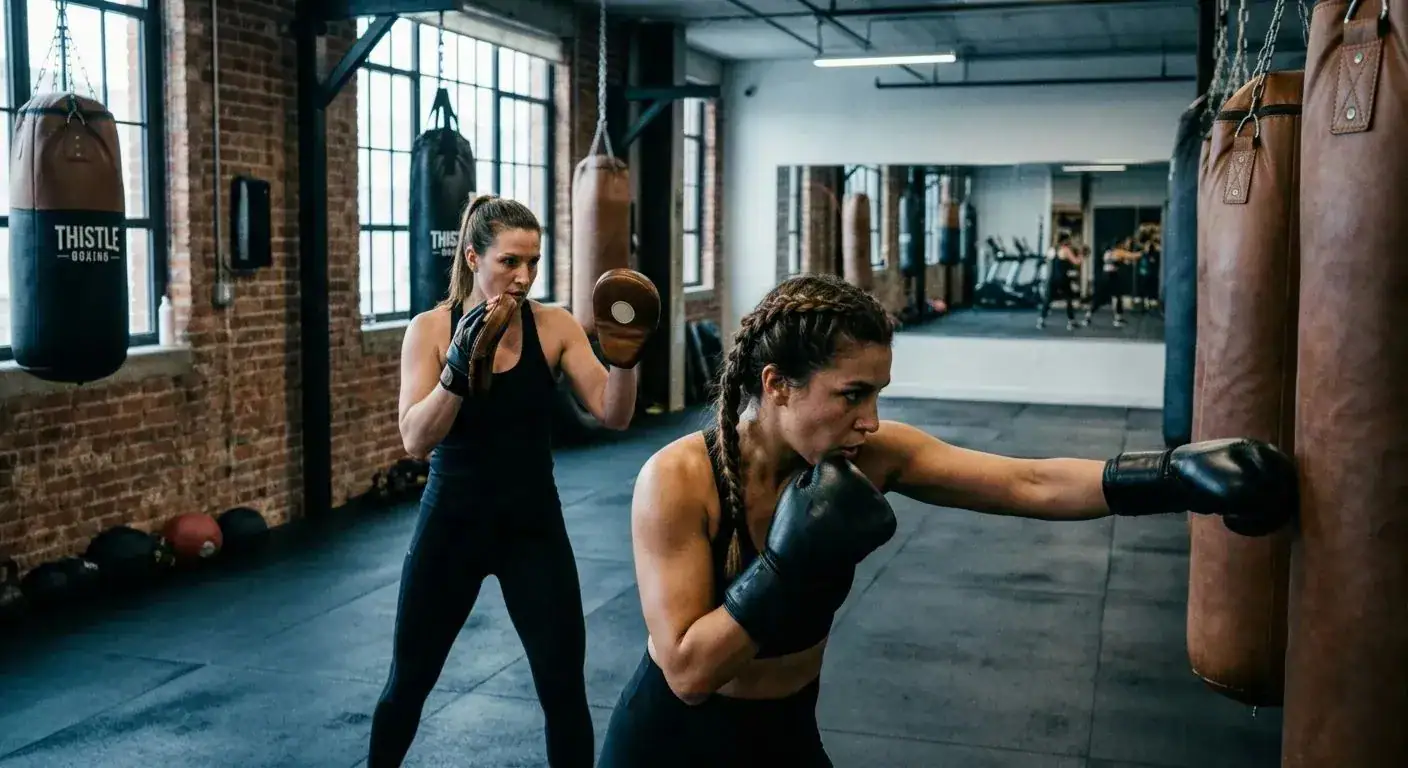
A typical class at Virago looks like this: a 10-minute warm-up of light cardio and shadow boxing, drills on the technical basics (stance, jab, cross, hook, uppercut), pad work or bag work in rounds, conditioning intervals (burpees, squats, abs), and a cool-down stretch.
Forty-five minutes to an hour, total. You’ll burn 500-700 calories. You’ll sweat through your shirt. Your shoulders will feel things they’ve never felt before. The day after, your obliques will remind you that punching is a full-body movement, not an arm movement.
What it does for your fitness
- Cardiovascular conditioning that rivals running, but more interesting.
- Shoulder, arm, and back strength from sustained punching.
- Core strength — every punch comes from rotation, which means abs and obliques work constantly.
- Footwork, agility, and coordination that translate to everything else you do.
- Reaction time and mental focus.
Within a few months of consistent boxing, most women notice their shoulders become more defined, their core gets visibly stronger, and their cardiovascular endurance jumps. The body changes are real, but they’re side effects of the more important thing boxing gives you.
What it does for your mind
This is the part nobody talks about enough.
Boxing is one of the most cathartic forms of exercise ever designed. There is something about hitting something — hard, deliberately, with proper technique — that releases stress in a way few other things do.
Women come to boxing for the workout and stay for the way it makes them feel afterwards. The bad day at work. The argument with a family member. The general weight of being a woman navigating expectations, pressure, judgement. Forty-five minutes of focused, controlled aggression dissolves it. You leave the gym a different person than the one who walked in.
This is not metaphor. This is the actual experience. Ask any woman who boxes regularly. She’ll tell you the same thing.
Why it’s particularly good for women
Three reasons that don’t apply equally to men:
One: most women have been taught, explicitly or implicitly, to suppress aggression. To be polite. To smile through frustration. Boxing gives that suppressed energy a healthy, contained outlet. You realise you have power you’ve never been allowed to use. You learn what your body can do when it’s not asking permission.
Two: women rarely feel physically capable in a confrontational sense. Boxing teaches you, in a very real way, that your body can protect itself. You don’t need to plan to ever use boxing self-defensively for this to matter. The knowledge that you could changes how you walk through the world.
Three: the focus required by boxing is meditative. You cannot be thinking about your inbox while throwing combinations. You cannot worry about a difficult conversation while learning to slip a hook. Boxing is one of the few workouts that fully empties your head. For women whose minds rarely stop running, this is a gift.
Common worries
“I don’t want to look aggressive.”
Boxing makes you more confident, not more aggressive. The women I’ve trained who box for years are some of the calmest people I know. The aggression has somewhere to go, so it doesn’t leak into other parts of life.
“I have weak wrists / small hands.”
Boxing teaches you to use your body, not just your fists. Proper technique transfers force from your legs and hips through your core to your hands. Even small hands throw hard punches with good form. You’ll be wearing wraps and gloves, which protect the wrists.
“I don’t want to actually fight anyone.”
Almost nobody at a fitness boxing class wants to actually fight. Pad work and bag work give you the experience of throwing real punches without sparring. Sparring is optional, separate, and you have to actively seek it out.
“I’m not coordinated.”
Nobody is coordinated when they start. Coordination is something boxing builds. By session four or five, you’ll surprise yourself.
What you need to start
- Comfortable workout clothes.
- Hand wraps (the gym usually provides or sells them).
- Gloves — the gym has loaner gloves for beginners. Buy your own after a few classes once you know you’ll stick with it.
- Water bottle.
- Willingness to feel uncoordinated for a couple of weeks.
What your first class will be like
You’ll learn the basic stance — feet shoulder-width apart, dominant foot back, knees soft, hands up. You’ll learn the jab — the straight lead-hand punch. You’ll feel awkward. Your hands will be slow. Your feet will get tangled. You’ll forget to keep your guard up. This is normal.
By the end of class, you’ll throw a punch that connects properly with a pad. The sound of a clean punch — the snap of the glove against the pad — is one of the most addictive sounds in fitness. The coach will smile. You’ll smile back, embarrassed. That’s the moment most women decide to come back.
The bottom line
Boxing isn’t for every woman. Some try it and prefer Zumba, or Pilates, or pure strength training. That’s fine.
But the women who connect with boxing tend to discover something about themselves they couldn’t have found in any other workout. A kind of physical and emotional decisiveness that doesn’t fade when you leave the gym.
Try one class. Throw one real punch. Then decide.