


Having a baby changes everything, including the body that’s trying to come back to the gym. The advice circulating online — “bounce back in six weeks!” — is harmful, unrealistic, and ignores most of what’s actually happened to a woman’s body.
Here is the honest, careful version of the conversation. Written for the woman who wants to return to fitness without setting herself back six months in the process.
First: timelines vary, and that’s okay
There is no single right timeline for returning to exercise after birth. The right timeline depends on:
- Whether you had a vaginal birth or C-section.
- Whether there were complications.
- How you’re feeling — physically and emotionally.
- How much support you have at home.
- How well you’re sleeping (this matters more than people realise).
Some women feel ready for light movement at four weeks. Some don’t feel ready until six months. Both are normal. The number that matters is the one your body gives you, not the one Instagram suggests.
The standard medical timeline
Most doctors clear women for general exercise at the 6-week postpartum check, or 8-10 weeks after a C-section. This clearance is a starting point, not a finish line. “Cleared for exercise” doesn’t mean “ready for HIIT.” It means you can begin returning gradually.
Before you do anything, see your doctor and, ideally, a women’s health physiotherapist. The physio can assess your core, your pelvic floor, and any diastasis recti — the abdominal separation that happens to most women during pregnancy. This assessment is gold. Skip it only if you have to.
What’s actually different about your postpartum body
Pregnancy and birth change much more than the visible bump:
- Your abdominal muscles have stretched and possibly separated. Diastasis recti affects about two-thirds of women and needs to be addressed before traditional ab work.
- Your pelvic floor has been stretched and may be weakened. Even after a C-section. Even if you didn’t push.
- Your hormones are still shifting, especially if you’re breastfeeding. Relaxin, the hormone that loosened your joints in pregnancy, can still be active months later.
- Your back, hips, and posture have all adapted to carrying the pregnancy, then to feeding, holding, and bending over a baby.
- Your sleep is broken. Recovery is harder when you haven’t slept four hours in a row in six weeks.
Treating your body the way you would have treated it before pregnancy is asking for injury and frustration. The body needs a different approach for the first 6-12 months, sometimes longer.
Phase 1: Weeks 0-6 (or 0-8 for C-section)
This is rest and gentle recovery. The only “exercise” you should be doing:
- Walking, starting with 5-10 minutes and building up gradually.
- Gentle breathing exercises that begin to reconnect you with your core and pelvic floor.
- Pelvic floor activation (Kegels, if you can feel them — many women can’t at this stage, which is fine).
- Stretching for upper back and chest if you’re hunching over from feeding.
No gym. No HIIT. No abs. No running. Your body is healing internally. Wounds you can’t see are still wounds.
Phase 2: After medical clearance (typically 6-12 weeks)
Now you can return to light gym work, but the priority is rebuilding the foundation, not chasing your old fitness:
- Walking, building up to 30-45 minutes daily.
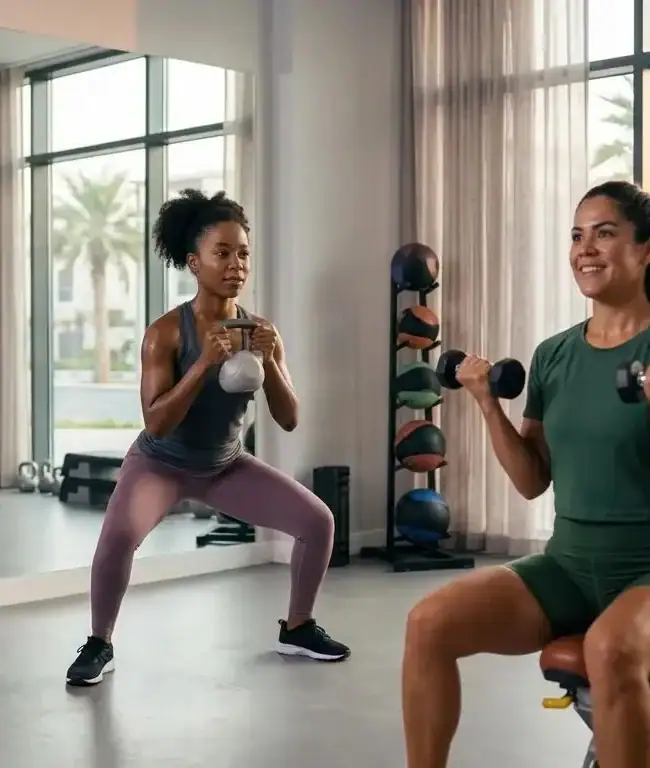
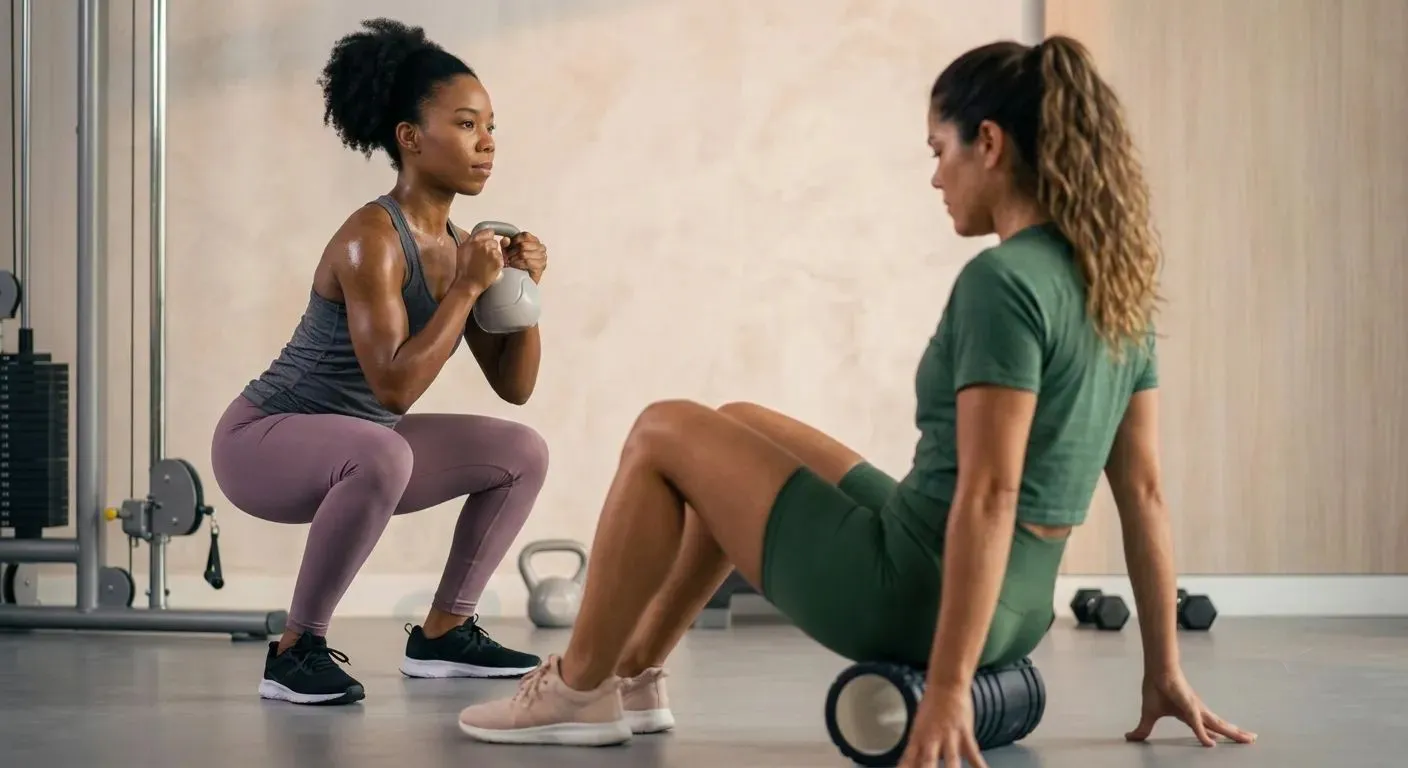
- Bodyweight strength work — squats, glute bridges, light rows.
- Postnatal Pilates or core rehabilitation work focused on the deep core, not crunches.
- Light dumbbell work for upper body, especially back muscles (counteracting the feeding posture).
- Pelvic floor training — ideally guided by a physio.
Avoid for now:
- Jumping, running, or anything high-impact.
- Heavy lifting (more than what your baby weighs is a reasonable rule for the first month back).
- Crunches, sit-ups, planks longer than 20 seconds, or anything that pushes the abdominal wall outward.
- Deep twisting movements.
Phase 3: Months 3-6 postpartum
Most women can now train in a more traditional way, with continued caution:
- Strength training with progressive load.
- Low-impact cardio — cycling, swimming, brisk walking.
- Gradual return to running, if you want to, after a proper pelvic floor assessment shows you’re ready.
- Group classes — but tell the coach you’re postpartum so they can scale appropriately.
Watch for warning signs:
- Leaking urine during exercise — sign that your pelvic floor isn’t ready for that level of impact yet.
- Pelvic heaviness or dragging feeling — same.
- Doming or coning in your abdominal wall during core exercises — diastasis isn’t fully healed.
- Persistent back pain that started after exercise.
Any of these means scale back, see a physio, and rebuild more slowly. They’re not failures. They’re information.
Phase 4: 6 months and beyond
For most women, full return to training is possible by 6-12 months postpartum — but “full return” means the training you did before, not necessarily the body you had before.
Be honest about what’s changed:
- Your sleep is probably still broken. Your recovery is slower than it was.
- Your stress levels are different. Cortisol affects body composition.
- If you’re breastfeeding, your body holds onto some fat for milk production. This is normal, useful, and goes away when you stop nursing.
- Your time is different. You may have less of it. Plan workouts accordingly.
The most successful postpartum fitness journeys aren’t about “getting your body back.” They’re about building a new relationship with the body you have now.
If you’re breastfeeding
- Eat enough. Aggressive dieting compromises milk supply.
- Drink more water than you think — feeding is dehydrating.
- A supportive sports bra is essential. Two might be more comfortable than one.
- Try to feed or pump just before working out so you’re not as full or leaking.
The mental side
Postpartum fitness is more emotional than people admit. The gap between your pre-baby body and your now body can be hard to sit with. Photos from a year ago can hurt. Other women’s apparent recoveries can sting.
Two things help:
One, remember that your body did something extraordinary. It built and birthed a human. The fact that it doesn’t look the same is not a failure. It’s evidence of work done.
Two, focus on capability over appearance. What can your body do today that it couldn’t do last month? Can you walk further? Lift more? Carry your baby for longer without your back hurting? These are the wins that matter and the wins that compound.
How Virago supports postpartum women
We see new mothers regularly, and we adjust for them. If you mention you’re postpartum, the coach will scale movements, watch for signs you’re pushing too hard, and check in on how you’re feeling — not just how you’re performing.
Many of our strongest, most consistent members had babies in the last three years. They didn’t bounce back. They built back. The difference is the timeline and the approach.
Final word
Returning to the gym after birth isn’t a race. It’s a rebuilding. Take it slowly. Honour what your body has done. Be patient with what it can’t yet do. The strength comes back. The energy comes back. The body comes back — different, often better, always changed.
And one day, maybe six months from now, maybe a year, you’ll catch yourself in the mirror after a workout and realise something has shifted. Not just in how you look, but in how you carry yourself.
That’s the body you actually wanted. The one that lifted heavy and built a human.